05

List item

Clear your calendar - It's going down! Splash Blocks kicks off on April 20th, and you're invited to take part in the festivities. Splash HQ (122 W 26th St) is our meeting spot for a night of fun and excitement. Come one, come all, bring a guest, and hang loose. This is going to be epic!

12:00 PM

Schedule Element

Clear your calendar - It's going down! Schedule Blocks kicks off on May 20th, and you're invited to take part in the festivities. Splash HQ (122 W 26th St) is our meeting spot for a night of fun and excitement. Come one, come all, bring a guest, and hang loose. This is going to be epic!

Ready

To Go

Clear your calendar - It's going down! Text Blocks kicks off on June 24th, and you're invited to take part in the festivities. Splash HQ (122 W 26th St) is our meeting spot for a night of fun and excitement. Come one, come all, bring a guest, and hang loose. This is going to be epic!

R. Harrison

CEO Barkbook

2018 POSITIVE PEACE CONFERENCE
Monday 
November 
05 
Tuesday 
November 
06
 - 

 Positive Peace provides a new way of conceptualizing development by placing the emphasis on what
 creates a thriving society, reframing our focus towards what works. There are tremendous benefits -
 economic, political, social and beyond - to making sound investments in building peace rather than
 merely preventing and mitigating conflict.


 The 2018 Positive Peace Conference will build upon two successful conferences, bringing together leading                   experts in Positive Peace: the attitudes, institutions and structures that prevent violence. Practitioners,  policymakers,   members of the media, corporate leaders, and representatives of fields like conflict prevention and sustainable   development, will come together to discuss new opportunities and challenges for strengthening Positive Peace.


 What Creates Peace?

 The tools for prevention exist, but we too rarely use them. Positive Peace can help change the conversation. 

                                                                                                                                                                                                                                                       The Institute for Economics and Peace (IEP) has sought to better understand the drivers of peaceful societies

 through the development of an empirical framework that identifies the optimum environment in which peace can

 flourish. This is termed Positive Peace. The main contribution has been the development of a framework of inter-

 related factors, identified by analyzing over 9,000 different indices, datasets and attitudinal surveys. The eight  pillars   of Positive Peace identified by IEP that are associated with peaceful environments are:


 Well-functioning government

 Sound business environment

 Equitable distribution of resources

 Acceptance of the rights of others

 Good relations with neighbors

 Free flow of information

 High levels of human capital

 Low levels of corruption


 Positive Peace provides a new way of conceptualizing development by placing the emphasis on what creates a   thriving society, reframing our focus towards what works. High levels of Positive Peace are a cross-cutting factor for   progress, making it easier for businesses to sell, entrepreneurs and scientists to innovate, individuals to produce,   governments to effectively regulate, and citizens to peacefully resolve conflict.

                                                                                                                                                                                                                                               Countries with higher levels of Positive Peace experience less violence, have stronger economies, and prove   significantly more resilient to shocks. Changes in Positive Peace are associated with changes in a number of                     macroeconomic indicators – GDP growth, FDI and credit ratings. Countries with higher levels of Positive Peace are less  likely to slip into major conflicts, are more likely to   experience  less violence, and are better equipped to bounce   back from internal or external shocks caused by   economic conditions, societal disagreements and natural disasters.   In fact, 84% of major political shocks and 91%   of violent civil resistance campaigns occurred in countries with lower   levels of Positive Peace. Yet the dearth of both research on and fiscal investment in strengthening  Positive Peace   heralds the need for greater global attention. This urgency is underpinned by the reality that the world is becoming   less peaceful.


 The Americas region offers a window into these dynamics, including record levels of migration, rampant
 corruption, police violence, and environmental threats. Through the lens of Positive Peace, speakers will
 explore practical solutions emerging from countries including Venezuela, Brazil, Guatemala, and Mexico.
 We will also discuss applications of Positive Peace for policy planning and community building in the United States - at   the local and national level.
 

 Previous conference panels have spanned atrocity prevention and psychology; the role of civil society
 actors including grassroots advocates and the media in promoting peace; and how data can be most 
 effectively harnessed for change. Considering that the Positive Peace framework offers a road map for
 peace to flourish over time, we hope you will join us in charting a path forward amidst some of the most
 pressing conflicts we face today, both at home and abroad.


 To learn more about last year's conference, click here.



2:00 PM

Opening Credits & Welcome Coffee

Enjoy a fresh cup of coffee before the presentations. We’ll be handing out pamphlets that outline this evening’s details.

12:00pm

Lunch Break

sponsored by wawa

November 
05
 at 
5:30pm
05

2018 POSITIVE PEACE CONFERENCE 

November 5-6

Add To Waitlist
Text goes here
X
About
Agenda
Speakers
Logistics
Contact
RSVP

YOU'RE INVITED TO

Envisioning a Positive Peace Agenda for the Americas

November 
05
 - 
6th 
2018

Friends and family:

 join us for drinks in celebration

of our engagement.

RSVPs Closed
Text goes here
X
Nov
 /
5
 - 
6
, 
2018
2018 POSITIVE PEACE CONFERENCE


5:30pm
 - 
8:30pm
RSVPs Closed
Text goes here
X

HOSTS


 Positive Peace provides a new way of conceptualizing development by placing the emphasis on what
 creates a thriving society, reframing our focus towards what works. There are tremendous benefits -
 economic, political, social and beyond - to making sound investments in building peace rather than
 merely preventing and mitigating conflict.


 The 2018 Positive Peace Conference will build upon two successful conferences, bringing together leading                   experts in Positive Peace: the attitudes, institutions and structures that prevent violence. Practitioners,  policymakers,   members of the media, corporate leaders, and representatives of fields like conflict prevention and sustainable   development, will come together to discuss new opportunities and challenges for strengthening Positive Peace.


 What Creates Peace?

 The tools for prevention exist, but we too rarely use them. Positive Peace can help change the conversation. 

                                                                                                                                                                                                                                                       The Institute for Economics and Peace (IEP) has sought to better understand the drivers of peaceful societies

 through the development of an empirical framework that identifies the optimum environment in which peace can

 flourish. This is termed Positive Peace. The main contribution has been the development of a framework of inter-

 related factors, identified by analyzing over 9,000 different indices, datasets and attitudinal surveys. The eight  pillars   of Positive Peace identified by IEP that are associated with peaceful environments are:


 Well-functioning government

 Sound business environment

 Equitable distribution of resources

 Acceptance of the rights of others

 Good relations with neighbors

 Free flow of information

 High levels of human capital

 Low levels of corruption


 Positive Peace provides a new way of conceptualizing development by placing the emphasis on what creates a   thriving society, reframing our focus towards what works. High levels of Positive Peace are a cross-cutting factor for   progress, making it easier for businesses to sell, entrepreneurs and scientists to innovate, individuals to produce,   governments to effectively regulate, and citizens to peacefully resolve conflict.

                                                                                                                                                                                                                                               Countries with higher levels of Positive Peace experience less violence, have stronger economies, and prove   significantly more resilient to shocks. Changes in Positive Peace are associated with changes in a number of                     macroeconomic indicators – GDP growth, FDI and credit ratings. Countries with higher levels of Positive Peace are less  likely to slip into major conflicts, are more likely to   experience  less violence, and are better equipped to bounce   back from internal or external shocks caused by   economic conditions, societal disagreements and natural disasters.   In fact, 84% of major political shocks and 91%   of violent civil resistance campaigns occurred in countries with lower   levels of Positive Peace. Yet the dearth of both research on and fiscal investment in strengthening  Positive Peace   heralds the need for greater global attention. This urgency is underpinned by the reality that the world is becoming   less peaceful.


 The Americas region offers a window into these dynamics, including record levels of migration, rampant
 corruption, police violence, and environmental threats. Through the lens of Positive Peace, speakers will
 explore practical solutions emerging from countries including Venezuela, Brazil, Guatemala, and Mexico.
 We will also discuss applications of Positive Peace for policy planning and community building in the United States - at   the local and national level.
 

 Previous conference panels have spanned atrocity prevention and psychology; the role of civil society
 actors including grassroots advocates and the media in promoting peace; and how data can be most 
 effectively harnessed for change. Considering that the Positive Peace framework offers a road map for
 peace to flourish over time, we hope you will join us in charting a path forward amidst some of the most
 pressing conflicts we face today, both at home and abroad.


 To learn more about last year's conference, click here.


Monday, November 5

Stanford Faculty Club


6:00 – 8:00 pm                 Opening Dinner


Tuesday, November 6

Stanford Graduate School of Business

(Vidalakis Dining Hall within the Schwab Residential Center)


9:00 – 10:00 am             Breakfast and Registration


10:00 – 10:10 am           Conference Opening


Dr. Alberto Diaz-Cayeros, Director, Center for Latin American Studies; Senior Fellow, Freeman Spogli Institute for International Studies (FSI); and Professor {by courtesy} in Political Science, Stanford University


Provash Budden, Regional Director of the Americas, MercyCorps


Michelle Breslauer, Director, Americas Program, Institute for Economics & Peace


10:10 – 10:20 am            Welcome


Dr. Francis Fukuyama, Olivier Nomellini Senior Fellow at the Freeman Spogli Institute for International Studies (FSI), and the Mosbacher Director of FSI's Center on Democracy, Development, and the Rule of Law


10:20 – 10:45 am           Opening Keynote and Presentation of the 2018 Positive Peace Report

The latest data-driven Positive Peace research will be presented, with a focus on how strengthening Positive Peace leads to economic and sustainable development.


Steve Killelea, Founder and Executive Chairman, Institute for Economics & Peace


10:50 – 11:55 am           Research Perspectives: Understanding Peace Systems

Following the presentation of the 2018 Positive Peace report, leading researchers will share reflections on the findings and discuss the connections between the framework and their own work spanning: community-level peace indicators, the role of non-violent movements, and how memory, culture, and meaning intersect with Positive Peace.


Moderator: Michelle Breslauer, Director, Americas Program, Institute for Economics & Peace


Dr. Naomi Levy, Associate Professor, Political Science Department, Santa Clara University and Lead Quantitative Investigator, Everyday Peace Indicators


Dr. Everard Meade, Professor of Practice, Joan B. Kroc School of Peace Studies, University of San Diego


Dr. Pushpa Iyer, Associate Professor; Director, Center for Conflict Studies; Chief Diversity Officer, Middlebury Institute of International Studies at Monterey


Dr. Stephen Zunes, Professor of Politics and International Studies, University of San Francisco and Member of the International Center on Nonviolent Conflict Academic Council


12:00 – 12:30 pm           Perspectives on key pillars of Positive Peace

A series of lightning talks illustrating research and programs related to key pillars of Positive Peace such as Sound Business Environment and Low Levels of Corruption.


Provash Budden, Regional Director of the Americas, Mercy Corps on opportunities for private sector engagement


Dr. Miriam Golden, Professor of Political Science, University of California, Los Angeles on what everyone needs to know about corruption


Dr. Saumitra Jha, Associate Professor of Political Economy, Stanford Graduate

School of Business on valuing peace


Mark Nelson, Researcher and Entrepreneur at Stanford Persuasive Technology Lab; Founder and Co-Director of Stanford Peace Innovation Lab on developing a peace data standard


12:30 – 1:30 pm            Lunch


1:35 – 2:50 pm              Practical Applications of Positive Peace

This panel will introduce concrete examples where the Positive Peace framework and relevant violence prevention and peacebuilding initiatives have been successfully implemented in different cities and regions of the Americas.


Moderator: Dr. Alberto Diaz-Cayeros, Director, Center for Latin American Studies; Senior Fellow, Freeman Spogli Institute for International Studies (FSI); and Professor {by courtesy} in Political Science, Stanford University (Country focus: Mexico)


Shannon Cosgrove, Director of Health Policy, Cure Violence (Country focus: U.S. cities)


Steve Hege, Senior Expert, Colombia, United States Institute of Peace (Country focus: Colombia)


Dr. Beatriz Magaloni, Professor in the Department of Political Science and Senior Fellow at the Freeman Spogli Institute for International Studies (FSI) at Stanford University (Country focus: Brazil/Mexico)


Marcelo Viscarra, Country Director, Mercy Corps Guatemala, Chief of Party,

CONVIVMOS (Country focus: Guatemala)


2:55 – 3:55 pm             Positive Peace, from Theory to Reality

Participants will be led through a mini-workshop to delve into the 8 pillars of Positive Peace and explore individuals’ own roles within this framework.


                                         Luis Gomez Chow, Deputy Director, Civil Society and LAC Programs, Partners

Global


4:00 – 5:00 pm                Local and Regional Planning for Resilience

How can local leadership and planning support sustainable development and resilience? The pillars of Positive Peace provide guidance about the active steps towards achieving targets such as the Sustainable Development Goals. Key initiatives highlighting the role of U.S. municipalities will be presented, along with the role that urban planning and development can play more generally in promoting peace, and equity, inclusion.


Moderator: Catherine Cheney, West Coast Correspondent, Devex And West Coast Ambassador, Solutions Journalism Network


Richard Marshall, International Strategy Director, Principal at Perkins+Will


Erin Bromaghim, Director of Olympic and Paralympic Development and Conrad N. Hilton Foundation Fellow on the SDGs, City of Los Angeles


Melika Edquist, Manager, UN Sustainable Development Solutions Network (SDSN)


5:05 – 6:05 pm            Building Networks for Positive Peace

Panelists will examine intersecting dimensions of collective action - including the efforts of youth, grassroots networks, media and faith groups - in fostering peace.


Moderator: Madeline Rose, Senior Global Advocacy Advisor, Mercy Corps


Summer Lewis, Coordinator, Rotary-IEP Partnership


Jamil Simon, Founder and President, Spectrum Media


Dr. William Vendley, Secretary General, Religions for Peace


Rudy Westervelt, CEO and Consultant, Power in Learning and Rotary Representative


6:05 – 6:30 pm              Reflections on the Day


6:30 – 7:30 pm               Reception


  Monday, November 5

  Stanford Faculty Club


  6:00-8:00 pm                    Opening Dinner (participants must confirm attendance in advance)


  Tuesday, November 6

  Stanford Graduate School of Business, Vidalkis Dining Room


  9:00 - 10:00 am                Breakfast and Registration

  10:00 – 6:30 pm              Conference Opening

  6:30 - 7:30 pm                  Reception                                                                                                                                     For the full agenda, please click here. 


Schedule

The full agenda can be viewed by clicking here. 

    nov. 5th 6:00 - 8:00pm

Opening Dinner at the Stanford Faculty Club, 439 Lagunita Drive  (REGISTRATION NOW CLOSED)

      nov. 6th 10:00AM - 6:30PM

Conference Program at the Stanford Graduate School of  Business (Vidalakis Dining Hall within the Schwab Residential Center) - 655 Knight Way, Stanford, CA 94305


Breakfast and registration: 9-10am

Conference program: 10am-6:30pm


       NOV. 6th 6:30 - 7:30PM

Reception at the Stanford Graduate School of Business, Vidalakis Dining Hall

Agenda

Speakers

Dr. Alberto Diaz-Cayeros

Director, Center for Latin American Studies; Senior Fellow, Freeman Spogli Institute for International Studies (FSI); and Professor {by courtesy} in Political Science, Stanford University

Dr. Beatriz Magaloni

Professor of political science at stanford university, senior fellow at the freeman spogli institute; and director of stanford's poverty, violence and governance lab.


Catherine Cheney 

West Coast Correspondent, Devex and West Coast Ambassador, Solutions Journalism Network

Dr. Clem McCartney

Policy and Content Coordinator, Shared Societies Project, World Leadership Alliance-Club de Madrid


Erin Bromaghim 

Director of Olympic and Paralympic Development and Conrad N. Hilton Foundation Fellow on the SDGs, City of Los Angeles

Dr. Everard Meade

Professor of human rights, history and peacebuilding at University of san diego

Dr. Francis Fukuyama

Olivier Nomellini Senior Fellow at the Freeman Spogli Institute for International Studies (FSI), and the Mosbacher Director of FSI's Center on Democracy, Development, and the Rule of Law. He is professor (by courtesy) of political science.

Jamil Simon

Producer Director, Founder and President of Spectrum Media

Luis Gómez Chow

Deputy Director, Civil Society and LAC Programs, Partners Global

Madeline Rose

Senior. Global Advocacy Advisor, MercyCorps

Marcelo Viscarra

Country Director, Mercy Corps Guatemala

Mark Nelson

Researcher and entrepreneur at Stanford Persuasive Technology Lab; founder and co-director of Stanford Peace Innovation Lab

Melika Edquist 

New York Manager, UN Sustainable Development Solutions Network (SDSN)

Michelle Breslauer

Director, Americas Program, Institute for Economics and Peace

Dr. Miriam Golden

Professor of Political Science at University of California. Fellow of the John Simon Guggenheim Memorial Foundation and an Associate Member of Nuffield College, Oxford

Dr. Naomi Levy

Associate Professor of Political Science at Santa Clara University

Provash Budden

Americas Regional Director ,Mercy Corps 

Dr. Pushpa Iyer

Associate Professor; Director, Center for Conflict Studies; Chief Diversity Officer Middlebury Institute of International Studies at Monterey

Richard Marshall

International Strategy Director, Principal at Perkins+Will

Rudy G. Westervelt

CEO And Consultant, Power in Learning and Rotary Representative

Dr. Saumitra Jha

Associate Professor of Political Science and of Economics (by courtesy), School of Humanities and Sciences, Senior Fellow, Stanford Institute for Economic Policy Research

Shannon Cosgrove

Director of Health Policy at Cure Violence

Steve Hege

Senior Expert, Colombia, United States Institute of Peace

Steve Killelea, AM

Executive Chairman And Founder, Institute For Economics And Peace

Dr. Stephen Zunes

Professor of Global conflict resolution, Nonviolence and politics of Middle East at University of San Francisco. 

Summer Lewis

Rotary-IEP Partnership Coordinator

Dr. William F. Vendley

Secretary General  At Religions for Peace International

LOGISTICS 

HOTELS

We recommend the following hotels:

Hotel Parmani | Palo Alto

Use our Promo Code: ENP

Rates:

Sunday 4th, November: $105 + tax

Monday 5th, November: $205+ tax

Tuesday 6th, November: $205 + tax

For a room with two beds add $10

For two-queen suite  add $20

Tel: 650.493.9085

Fax: 650.493.8405
www.hotelparmani.com


Hotel Keen | Palo Alto

Rates:  

$349 per night + tax (parking and breakfast included)

Tel: 650.323.5101

www.hotelkeen.com


Comfort Inn | Palo Alto

Rates: $290 + tax 

www.paloaltoci.com

Tel: 650.493.2411


LOCATION & SHUTTLE

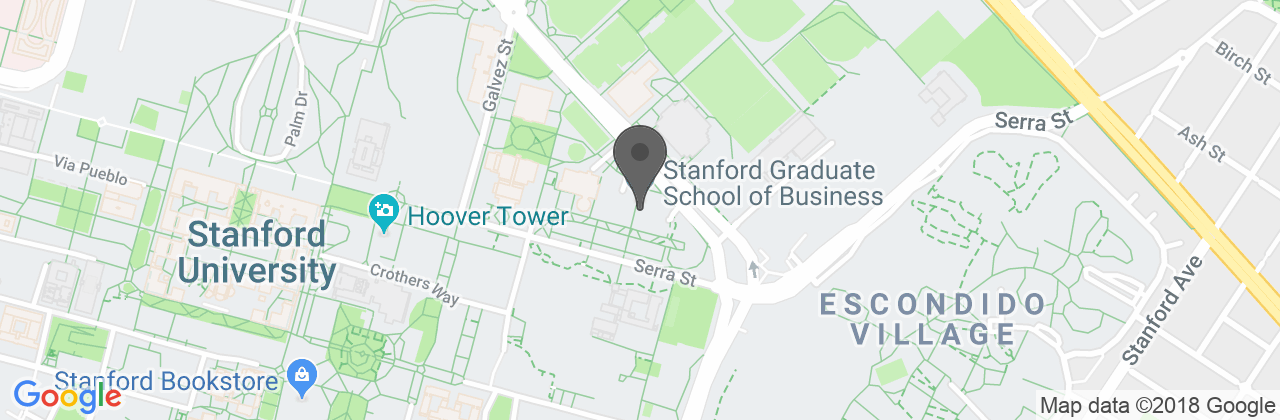
 Tuesday's conference is at the the Stanford University Graduate School of Business (Vidalakis Dining Hall within the Schwab Residential Center) - 655 Knight Way, Stanford, CA 94305. 


 On Tuesday, a free shuttle will depart to Stanford from the following hotels at the corresponding times – please plan to arrive five minutes early as the shuttle will not wait for anyone.


Morning shuttle schedule:

8:40am: Hotel Parmani, 3200 El Camino Real

8:50am: Comfort Inn, 3945 El Camino Real 

9:00am: Sheraton Hotel, 625 El Camino Real (Westin guests should walk 2 minutes to be picked up at the Sheraton Hotel)

9:10am: Hotel Keen, 425 High St (Cardinal guests should walk 5 minutes to be picked up at Hotel Keen)


Evening shuttles will leave Stanford at 6:40pm and 7:40pm and return to these same hotels.

MEALS 


The conference will kick off with a dinner on Monday, November 5 at the Stanford Faculty Club (you must have confirmed your registration and received confirmation in order to attend).


Meals and coffee breaks will be provided to all confirmed participants for the full-day conference on Tuesday, November 6.
TRAVEL

The conference is free to attend, however participants are required to register and confirm in advance and to pay for their own travel costs. 


PARKING


Updates coming soon!


Address


map-1536347096.960x210.png

KEY SESSIONS

1

POSITIVE PEACE & SYSTEMS THINKING

What is the state of empirical knowledge about risk factors versus long-term drivers of peace? What are some unanswered questions about positive peace, and how can they be answered? Is there sufficient data available? What new data needs to be collected? This session will examine positive peace through the lens of systems thinking. It will show the fundamental interrelationships between positive peace factors such as good governance and control of corruption, as well as shed light on the key challenges of tipping countries trapped in vicious cycles of conflict and violence into more positive feedback loops.

2

POSITIVE PEACE CASE STUDIES 

How is information captured about positive counter-examples at the country and community level? What are the methodological challenges to building a library of positive peace case studies? What data needs to be collected? How can case studies be used as a peacebuilding tool? This session  will feature commissioned case studies by leading academics and practitioners. It will also feature IEP’s work on positive peace in Mexico.

4

BUILDING THE CASE FOR PREVENTION

 How do you build support for investments that may take a decade or longer to pay off? Are there interim milestones of success that can be identified? How do you translate systems thinking (which emphasizes the interrelationships between various positive peace factors) into ways that are concrete and measurable for policymakers and practitioners? 

CONFERENCE ORGANIZERS

#positivepeace2017

positivepeace2018

What Creates Peace?

The tools for prevention exist, but we too rarely use them. Positive Peace can help change the conversation.

The 2018 Positive Peace Conference will bring together leading experts in positive peace: the attitudes, institutions and structures that prevent violence. Practitioners, policymakers, members of the media, corporate leaders, and representatives of fields like atrocity and conflict prevention and humanitarian assistance, will come together to discuss new opportunities and challenges for strengthening positive peace.

Participants will explore Positive Peace through the lenses of research, policy, and practice to explore the peace systems that operate in our communities and countries.

The Time is Now

The number of people impacted by armed conflict is higher now than at any time since World War II. Violence and conflict continue to thwart basic humanitarian goals and prevent progress on challenges from climate change to poverty reduction. In 2017, 12.4% of the global economy was absorbed by the consequences of violence. Yet comparatively little is spent on proactive investments to eradicate the underlying conditions that lead to violence or conflict. Despite a rhetorical commitment to prevention, all too often the global policymaking community is focused on the crisis of the day, intervening too late to make any meaningful impact.

The Institute for Economics and Peace (IEP) has sought to better understand the drivers of peaceful societies through the development of an empirical framework that identifies the optimum environment in which peace can flourish. This is termed Positive Peace. The main contribution has been the development of a framework of inter-related factors, identified by analyzing over 4,700 different indices, datasets and attitudinal surveys. The eight pillars of Positive Peace identified by IEP that are associated with peaceful environments are:

 ·      Well-functioning government

·      Sound business environment

·      Equitable distribution of resources

·      Acceptance of the rights of others

·      Good relations with neighbors

·      Free flow of information

·      High levels of human capital

·      Low levels of corruption

 Positive Peace provides a new way of conceptualizing development by placing the emphasis on what creates a thriving society, reframing our focus towards what works. High levels of Positive Peace are a cross-cutting factor for progress, making it easier for businesses to sell, entrepreneurs and scientists to innovate, individuals to produce, governments to effectively regulate, and citizens to peacefully resolve conflict.

High Positive Peace = Greater Resilience

Countries with higher levels of Positive Peace are less likely to slip into major conflicts, are more likely to experience less violence, and are better equipped to bounce back from internal or external shocks caused by economic conditions, societal disagreements and natural disasters. In fact, 84% of major political shocks and 91% of violent civil resistance campaigns occurred in countries with lower levels of Positive Peace.

Share with Friends
Facebook
Twitter
LinkedIn
Link
Powered by
CONTACT THE ORGANIZER
Google   Outlook   iCal   Yahoo
Sorry, RSVPs have closed.